

From that experience, I'll give the conclusion plainly.
If you want to finish band sound in home recording, it has more than enough. Let me put together what I've felt.
The conclusion first (key points of this article)
・111 amps / 106 cabinets / 111 effects cover the sound for every band part
・Proprietary VIR™ and DIM™ technologies make home-recorded guitar sound "thick"
・With TONEX integration, sounds captured with AI can be used as they are
・The definitive choice for people who find Logic Pro's built-in Amp Designer lacking
・The list price is on the high side, but big discounts are a regular thing at sales, so it's worth aiming for
If you want more, there are bundles such as "Total Studio 5 MAX." Prices and sale details change, so please check the product page before buying.
AmpliTube 5 MAX v2 in Three Lines
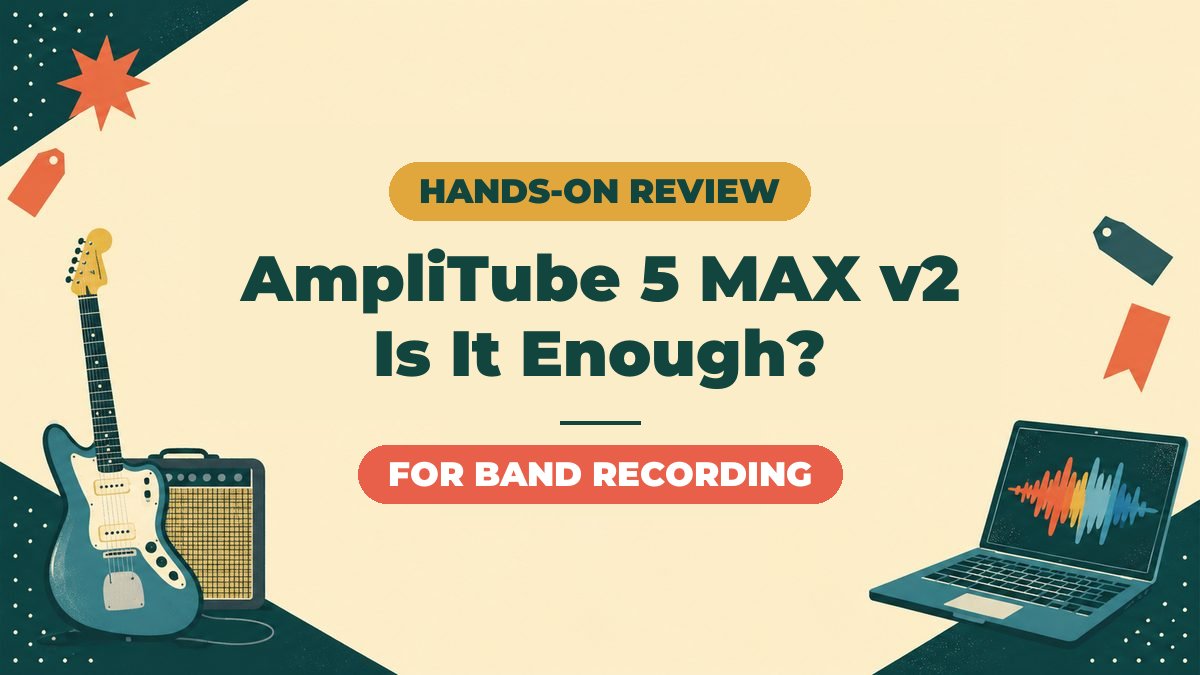
AmpliTube 5 MAX v2 is the top edition of the guitar/bass amp simulator.
It is a plugin IK Multimedia has developed for more than 20 years.
It puts 435 gear models in one plugin.
It includes officially licensed Fender, Mesa/Boogie and Marshall-type models.
There are two biggest additions in v2.
One is integration with the company's "TONEX," which brings in sound with AI machine modeling.
The other is integration of "ToneNET," the preset sharing platform.
If you're wondering "what is an amp simulator?", reading the amp sim basics article first helps you picture it.
"With an amp simulator, what do I actually connect to what?" When you start recording guitar in DTM, this is the first question you run into. There are lots of knobs, and the order of effects isn't clear either. Raise the gain and the sound gets crushed, lower it and it lacks punch. This article explains amp simulators. I'll break down the basic signal chain order and how to think about gain from the point of view of a home-recording guitarist. I've left out difficult theory as much as possible. Learn this shape first, and you can apply it from ...
Amp Simulator Basics | Signal Chain Order and How to Think About Gain
AmpliTube 5 MAX v2 vs the Free CS, SE and Standard
AmpliTube 5 comes in four grades.
The difference is the number of gear models included.
| Item | CS (free) |
SE | Standard | MAX v2 |
|---|---|---|---|---|
| Total gear models | 41 | 80 | 183 | 435 |
| Amps | 6 | 13 | 35 | 111 |
| Cabinets | 7 | 14 | 28 | 106 |
| Stompboxes | 10 | 19 | 46 | 111 |
| Rack effects | 6 | 14 | 40 | 48 |
| Mics | 3 | 5 | 11 | 18 |
*The numbers follow the version comparison table on the IK Multimedia official site.
Standard (35) and MAX v2 (111) differ by more than three times in the number of amps.
Licensed collections such as Fender and Mesa/Boogie are included in MAX v2.
Who the Free or Standard Is Enough For, and Who Should Choose MAX v2
If a clean tone and a few standard distortions are enough, you can do home recording with the free CS.
Many people try the feel with CS first, then choose a higher version once sounds they lack come up.
On the other hand, MAX v2 suits people like these.
- Want the sound of every band part, guitar and bass, in one plugin
- Want to use real-gear brand sounds such as Fender and Mesa/Boogie
- Want to build in detail, down to combinations of cabinet and mic
From Standard to MAX v2, IK officially offers an upgrade version too.
Before buying, check the price that matches the grade you own.

The Author's Home-Recording Setup (the Premise of This Review)
ryo's home-recording setup
- Guitar experience: 13 years (centered on alternative, grunge and other textural sound)
- DTM experience: 8 years (started with iPad + iRig, then moved to Mac + Logic Pro)
- I/F (audio interface): Apollo Twin Solo
- Plugins owned: TONEX MAX / AmpliTube 5 / UAD Sound City Studios and more
- Band work: producing and reviewing home-recorded demos via Google Drive sharing with members
5 Reasons It's "Enough" for a Band Player's Home Recording
Now the main part. Why does this hit home for a home-recording band player focused on line recording?
I explain it in five points.
1. 435 gear models | The sound for every part is there
MAX v2's biggest strength is sheer quantity.
Specifically, it is organized like this.
| Category | MAX v2 count | Main contents |
| Amps | 111 | Fender '59 Bassman / Mesa/Boogie Dual Rectifier / Orange AD 200 / Marshall JCM800-types and more |
| Cabinets | 106 | 1x12 to 8x10, re-captured with VIR™ |
| Stompboxes (effects) | 111 | OD, fuzz, modulation, Brian May / Satriani licensed models and more |
| Rack effects | 48 | Studio processors including 23 derived from T-RackS 5 |
| Speakers alone | 33 | Swappable between cabinets |
| Mics | 18 | Condenser, dynamic, ribbon |
| Rooms | 8 | From a bathroom to a large studio |
It covers clean, crunch, high gain, bass and even acoustic-like tones used in a band.
That it's complete in one plugin is quietly big.
Alternative, grunge and post-rock.
Whatever the genre, being able to switch between multiple tones quickly is its strength.
2. VIR™ and DIM™ | Why Home-Recorded Guitar Sounds "Thick"
More effective than the numbers is how the sound itself is made.
MAX v2 includes two proprietary technologies.
VIR™ (Volumetric Impulse Response)
Captures 600 IRs per speaker. Over 140,000 in total. You can move the mic in millimeter steps in the 3D space in front of the cabinet.
DIM™ (Dynamic Interaction Modeling)
Models even how each circuit inside the amp affects the others. The "response" when you turn a knob is close to a real amp.
Home-recorded line guitar tends to be called "thin" and "floating."
Thanks to VIR™, I got the feel that just moving the mic slightly completely changes how thick the sound is.
It's the same for thick guitar sounds like alternative and grunge.
Try shifting the main mic a few centimeters from the center toward the edge.
The "wall" of roar gains a level of depth.
3. TONEX integration | The Highlight of v2
The most revolutionary thing in v2 is TONEX integration.
TONEX is separate software that "captures" real gear's sound with AI. The signal chain of AmpliTube 5 MAX v2 has evolved.
You can now plug in TONEX Tone Models as they are.
The image is that you can put your own personal amp on AmpliTube's wide board.
That amp is one you captured with TONEX.
This is a spec where people who own both benefit most.
It's even more convenient if, like me, you also own TONEX MAX.
You can use other people's captures downloaded from ToneNET.
You can also put Tone Models you made yourself anywhere in AmpliTube's chain, before or after the distortion.
You can run a hybrid of "AmpliTube's effects plus TONEX's amps."
In effect, there is no sound left that you lack.
4. The 8-Track Recorder Makes a Demo to Share with Members Instantly
This is a point that works more than you'd expect from a band player's view.
AmpliTube 5 MAX v2 can be launched standalone.
The built-in 8-track recorder works as a simple DAW.
"The moment an idea comes, record it quickly before launching Logic Pro."
"Export a rough mix to share with members and upload it to Google Drive."
This is all complete in one plugin.
You can also import audio with SpeedTrainer.
You can slow only the playback speed without changing pitch, so it's also useful for copying reference songs and picking out parts by ear.
5. Live Mode | You Can Take It to Rehearsals and Gigs
It tends to be thought of as home-recording only, but AmpliTube 5 MAX v2 has a live mode.
You can optimize the UI for live use.
You can switch presets with a MIDI-capable foot controller.
You can use the BOSS GT-1000 CORE or AXE I/O.
With a laptop, an audio interface and a foot controller, you can handle rehearsals and small gigs.
In live use, the stability of your PC is everything.
Be sure to optimize, such as turning off power saving and stopping background software.
What I Found After Heavy Use: How It Feels for Alternative Home Recording
From here I introduce specific usage scenes.
Basic Line Recording Steps (Logic Pro + Apollo Twin Solo)
My home-recording flow goes like this.
step
1Guitar → Apollo Twin Solo (Hi-Z input) → Mac
Because it's a line input, I first record the raw DI signal into Logic Pro.
step
2Insert AmpliTube 5 MAX v2 on the Logic Pro track
Insert it in the plugin slot. The strength is that you can process the raw DI with amps and effects afterward.
step
3Choose a preset and fine-tune the mic and cabinet
Thanks to VIR™, you can move the mic position in millimeter steps.
step
4Export and share with members
Upload to Google Drive and share by chat, and that's it.
You can endlessly say "actually I want a bit more distortion" or "I want to change the mic" afterward. It really suits band players who rework demos many times.
If you aren't sure about the difference between line and mic recording, reading this article first clears it up.
-

-
Line Recording vs Mic Recording for Home Guitar | A Conclusion from 8 Years of Experience
Struggling Between Line and Mic Recording for Home Guitar? When you record guitar at home, the first thing you run into is choosing between "line recording" and "mic recording." The short answer: a guitarist who is just starting home recording should go with line recording. But this does not mean "mic recording is bad." Each has what it suits and doesn't. In this article, I'm ryo, 13 years of guitar and 8 years of DTM, and I sort it out. Based on experience using both, I put together the differences and how to choose. What Is the Difference Between Line ...
An Example Chain for the Alternative "Wall of Sound"
This is for when you build thick sounds like alternative and grunge.
I use reverb and delay.
Inside AmpliTube 5 MAX v2, I build it like this.
Example chain (left to right)
Compressor → reverse reverb → fuzz-type stomp → high-gain amp (Mesa/Boogie-type) → VIR™ 1x12 cabinet plus ribbon mic → large room → modulation → long delay → plate reverb
The point is to put the reverse-type effect before the distortion.
That alone gets you much closer to "that wall of sound."
Sharing Demos with Members (Google Drive Workflow)
I have a routine for exchanging songs with band members.
I upload a 2-mix export plus the Logic project file to Google Drive.
AmpliTube 5 MAX v2 saves its preset information inside the project.
The good thing is that the moment a member opens it in Logic Pro, it plays with the same sound.
Fewer rounds of "how did you make that guitar sound?" is quietly a direct efficiency gain.
Choosing Between It and TONEX MAX | My Conclusion as an Owner of Both
This is a part I can write thanks to owning both.
| Use | Better fit |
| Want to perfect the sound of one "this is it" amp | TONEX MAX |
| Want to use several amps within the same song | AmpliTube 5 MAX v2 |
| Want to finish a wide range of stompboxes and time-based effects inside the plugin | AmpliTube 5 MAX v2 |
| Want to get close to the feel of real gear / play with other people's captures | TONEX MAX |
| Want to streamline line recording → post-processing | Either works (they integrate) |
"TONEX for a single amp, AmpliTube for the whole board." Thanks to v2's TONEX integration, I think there's almost no reason left to buy only one of them.
I plan to put together a deeper comparison of TONEX vs AmpliTube in a separate article. "For home guitar recording, I want to start with one amp simulator." When you think that, the first wall you hit is TONEX or AmpliTube 5: which one should you build around? Both are made by IK Multimedia. The names are similar, and honestly it is confusing. In this article, I'm ryo, with 13 years of guitar and 8 years of DTM. I'll compare them honestly as someone who owns and uses both. I won't just list specs. I'll focus on which one you can build around without regrets. Recommended for Anyone who can't quite tell TONEX and AmpliTube 5 ...
TONEX vs AmpliTube 5 | Which Should a Home-Recording Guitarist Build Around? A Comparison from an Owner of Both
Pros and Cons Summary
Pros
・Overwhelming number of amps and effects: covers every band part
・VIR™ and DIM™ make "thick home-recorded guitar" realistic to build
・TONEX integration fills in "sounds you lack" with AI captures
・A chain with great freedom, able to line up as many as 57 models at once
・Standalone plus the 8-track recorder gives instant demos
・Live mode supports stage use too
Cons and cautions
・As a single plugin, the CPU load is on the heavy side: adjusting the buffer size is a must
・With so many models, you get lost at first
・The list price is high, so aiming at the sales described below is realistic
・Uploading sounds to ToneNET is currently US-only
I'll touch on CPU load too.
Set the sample rate to 44.1 to 48 kHz and the recording buffer to 128 or less.
Raising it to 512 to 2048 when mixing keeps it within a practical range.
Who I Recommend It To and Who I Don't
People I can recommend it to
- Band players who want to use many kinds of amps within one song
- People who focus on line recording and want to build the sound in post
- People who've started to find Logic Pro's built-in Amp Designer lacking
- People who already own TONEX and want to expand their effects board
- Genres where "sound design is everything," such as alternative / post-rock
People I don't recommend it to so much
- People who know they want just one or two sounds and need nothing more (TONEX is enough)
- People home recording on a weak PC (check CPU load with the demo before buying)
- People who finish with only a single simple clean tone
How to Buy and the Best Timing
AmpliTube 5 MAX v2 can be bought from the IK Multimedia official site.
Plugin specialty stores such as Plugin Boutique are also an option.
The list price is high, but there is one important point here.
Keep an eye on Black Friday (BF below) every year.
A "two-in-one bundle" of TONEX MAX and AmpliTube 5 MAX comes out at a big discount.
It has been a regular event for two years in a row, and in the past there were years with more than 80% off the combined list price.
If you aren't in a hurry, waiting for BF or the summer sale is the most realistic way to buy.
The latest BF sale information is being updated as it comes in at the Black Friday guide for guitarists.
To give the conclusion first, the main day of Black Friday 2026 is Friday, November 27. The first thing a guitarist should aim at is the TONEX MAX + AmpliTube 5 MAX two-in-one bundle. For the past two years in a row, there has been a sale where "buy one and get the other free." Black Friday (BF below) is the time of year when DTM plugins get cheapest. Discounts of 50 to over 80% are not rare. But if you buy everything in sight just because it's cheap, you only add to your pile of unused plugins. This page ...

Black Friday 2026 Guide for Guitarists | TONEX, AmpliTube, UAD and How to Buy Without Regret
You also get other plugins such as TONEX MAX together.
About Total Studio 5 MAX
A bundle that gets you AmpliTube 5 MAX v2, TONEX MAX and more together. Prices and sale details change, so always check the product page before you buy.
-
-
Total Studio 5 MAX V2 Explained: What Changed from 4 MAX, MAXgrade and Prices
"What actually changed in Total Studio 5 MAX V2? If I already own 4 MAX, should I upgrade?" If you use IK's bundles, you've probably wondered about this at least once. What you'll learn in this article What's in Total Studio 5 MAX V2 (the headliners: TONEX, AmpliTube, MODO DRUM) What changed from 4 MAX Standard vs. upgrade vs. MAXgrade, and prices Whether 4 MAX owners should upgrade The Short Answer: 4 MAX Owners Don't Need to Rush TONEX, AmpliTube and MODO DRUM, the core of a home-recording guitarist's setup, are already in 4 MAX. So if you own 4 ...
Check out Total Studio 5 MAX now
FAQ
Q. Isn't Logic Pro's built-in Amp Designer enough?
If it's only simple clean to crunch, the built-in one is enough.
But it has limits.
That's the moment you really want fine control of mic position or running several amps in parallel.
You start wanting to go where Amp Designer can't reach. That timing is the signal to introduce AmpliTube.
Note that Logic Pro's own price changes with timing and region.
The latest price is most reliably checked on Apple's official site.
Q. TONEX or AmpliTube: which should I buy first?
If you "want to perfect one amp," it's TONEX.
If you "want to freely build multiple amps plus effects," it's AmpliTube.
I myself bought TONEX MAX first and then expanded to AmpliTube.
But if you want to finish band home recording in one plugin, I think satisfaction is higher starting with AmpliTube.
Q. Can I upgrade from an older AmpliTube?
This applies if the license is tied to your IK Multimedia official account.
Crossgrade and upgrade campaigns come out regularly.
Especially around BF, you can expect deeper discounts than usual, so waiting for the season is an option.
Q. What if the CPU load feels heavy?
Set the sample rate to 48 kHz.
Set the buffer size to 128 or less while recording, and raise it to 512 to 2048 once you move to mixing.
That usually solves it.
On Windows, set the power plan to "High performance."
On Mac, the basic move is to close background apps as much as you can.
Summary: The Top Pick If You Want to Finish Band Home Recording with One Plugin
Summary of this article
・AmpliTube 5 MAX v2 is enough for a band player's home recording
・VIR™ / DIM™ make "thick home-recorded guitar" realistic to build
・TONEX integration can cover "sounds you lack" too
・The list price is high, so aiming at BF and big sales is the smart way to buy
・If you already own TONEX, adding it costs you nothing in regret
I think AmpliTube 5 MAX v2 will become the option you arrive at first and that stays to the end. I'll check BF movements on this blog too.
Also worth reading "Aren't all amp simulators basically the same?" Honestly, I used to think so too. But after I started using TONEX MAX, that idea was completely turned upside down. In this article, I'll share my honest impressions after using TONEX MAX heavily for home guitar recording over the years. The short version: it is my favorite guitar plugin right now. What you'll learn in this article Why TONEX MAX has an "air" that others don't My honest impressions from using it in home recording What kind of guitarist it suits What Is TONEX MAX? The Basics, Quickly TONEX MAX is software ... "For home guitar recording, I want to start with one amp simulator." When you think that, the first wall you hit is TONEX or AmpliTube 5: which one should you build around? Both are made by IK Multimedia. The names are similar, and honestly it is confusing. In this article, I'm ryo, with 13 years of guitar and 8 years of DTM. I'll compare them honestly as someone who owns and uses both. I won't just list specs. I'll focus on which one you can build around without regrets. Recommended for Anyone who can't quite tell TONEX and AmpliTube 5 ... To give the conclusion first, the main day of Black Friday 2026 is Friday, November 27. The first thing a guitarist should aim at is the TONEX MAX + AmpliTube 5 MAX two-in-one bundle. For the past two years in a row, there has been a sale where "buy one and get the other free." Black Friday (BF below) is the time of year when DTM plugins get cheapest. Discounts of 50 to over 80% are not rare. But if you buy everything in sight just because it's cheap, you only add to your pile of unused plugins. This page ... Struggling Between Line and Mic Recording for Home Guitar? When you record guitar at home, the first thing you run into is choosing between "line recording" and "mic recording." The short answer: a guitarist who is just starting home recording should go with line recording. But this does not mean "mic recording is bad." Each has what it suits and doesn't. In this article, I'm ryo, 13 years of guitar and 8 years of DTM, and I sort it out. Based on experience using both, I put together the differences and how to choose. What Is the Difference Between Line ...

TONEX MAX Review | An Honest Take, Plus How It Differs from SE, Standard and the Free CS
TONEX vs AmpliTube 5 | Which Should a Home-Recording Guitarist Build Around? A Comparison from an Owner of Both
Black Friday 2026 Guide for Guitarists | TONEX, AmpliTube, UAD and How to Buy Without Regret
Line Recording vs Mic Recording for Home Guitar | A Conclusion from 8 Years of Experience