"My home-recorded guitar always sounds disconnected from the mix."
That was a problem I dealt with for a long time.
The tone itself wasn't bad.
But next to real drums and bass, my guitar always sounded like it was recorded in a different room.


One plugin fixed that "disconnected" feeling almost instantly: UAD Sound City Studios.
I've been playing guitar for 13 years and producing music at home for 5. In this review, I'll share my honest, long-term experience with this plugin.
For context, my own taste leans toward 90s alternative, shoegaze, and grunge.
Who this review is for
- Your home-recorded guitar sounds disconnected from the rest of the mix
- You want more room ambience and "air" on your home-recorded guitar
- You're deciding whether UAD Sound City Studios is worth buying
What Is UAD Sound City Studios?
UAD Sound City Studios is a plugin made by Universal Audio (UA).
It models the entire sound of Sound City Studios, the legendary recording studio in Van Nuys, California.
Sound City is where Nirvana recorded Nevermind (1991), along with Fleetwood Mac, Tom Petty, and many other rock landmarks.
The studio is especially famous for its drum sound.
But this plugin isn't limited to drums.
It can place guitars, vocals, bass, and full ensembles into that same room.
Legendary Bands and Artists Recorded at Sound City
The fastest way to understand why this studio matters is to look at who recorded there.
- Nirvana – Nevermind (1991)
- Fleetwood Mac (their 1975 self-titled album, plus parts of Rumours)
- Tom Petty and the Heartbreakers – Damn the Torpedoes
- Neil Young – After the Gold Rush
- Rage Against the Machine
- Red Hot Chili Peppers
- Metallica
- Tool
- Nine Inch Nails
- Weezer
- Johnny Cash
- Slayer
- Guns N' Roses
Alternative, grunge, hard rock, metal — some of rock's most important records were born here.
Check the current price on Plugin Boutique
Using It as a Re-Mic Plugin
In short, this plugin is a Re-Mic plugin.
It takes a sound you've already recorded (or programmed) and makes it sound like it was re-recorded through Sound City's rooms and microphones.
That means the workflow is simple.
You just drop it in after a plugin like TONEX.
My Honest Impression: The "Disconnected" Guitar Problem Actually Disappeared
The first thing that surprised me was how quickly my original problem was solved.
I applied Sound City's Re-Mic mode lightly on top of a TONEX MAX guitar tone.
That alone made the guitar sound like it was sitting in the same room as the drums.
Part of why I like TONEX MAX in the first place is its sense of "air." Sound City took that a step further.
[Comparison Video] Plugin OFF vs. ON (Guitar)
I made a comparison video for guitar as well.
You can hear the same phrase with the plugin OFF, then ON.
The preset used is "Attitude Cab V - Gobos." Listen for how much depth and cabinet-style ambience it adds.
Where Should You Place It in the Chain?
People often ask, "Should a re-mic plugin go first in the chain?"
But placing it before your tone-shaping plugin is a mistake.
Re-Mic re-records a sound that's already finished.
So it belongs after you've already shaped the tone.
Basic Placement Rules
- Guitar: place after your amp sim (e.g. TONEX) has already shaped the tone
- Drums: apply to the stereo drum bus
- For subtle blending: put it on an aux/bus and mix it lightly under the dry signal
UA's official manual describes both approaches: inserting directly on a track, or applying it to a bus that combines multiple tracks.
In my experience, using it on a bus and blending it lightly was the easiest way to work with it.
Rather than replacing your sound entirely with Sound City, think of it as adding a layer of room air underneath your original tone. That's what tends to work best for home recording.
Dynamic Room Modeling Is the Core Technology
The heart of this plugin is Dynamic Room Modeling.
It models the room, microphones, console, and outboard gear together as one system.
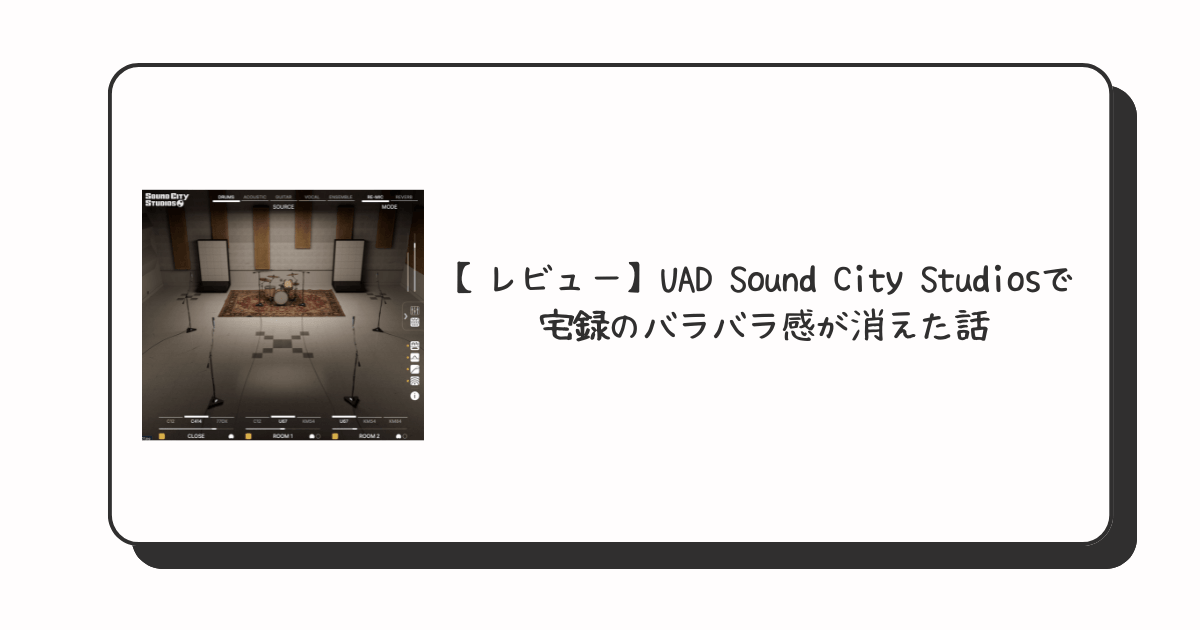
One especially interesting feature: you can drag the microphone position.
Moving the mic closer or farther from the source changes how the room responds in real time.
Included Microphones
Two Modes You Can Switch Between
There are broadly two modes.
- Re-Mic mode: replaces your recorded sound with one that sounds re-recorded at Sound City
- Reverb mode: adds Sound City's ambience as a blend on top of your existing sound
For guitar, I mostly use Re-Mic lightly on a bus.
Push it too hard and it adds too much character. I found keeping the Mix knob around 20–40% worked well for home recording.
Not Just Guitar — I Tried It on Every Part
I originally bought this plugin for guitar.
But over time, I started reaching for it on vocals, bass, and drums too.
| Part | Impression |
| Drums | The biggest change. Even programmed drums gain a natural, live feel |
| Vocals | Adds distance and shine, helps them sit in the track |
| Bass | Low end finds its "place" and the core of the sound comes forward |
| Guitar | Disconnected feeling disappears and it locks into the mix (as above) |
The Biggest Change Was on Drums
Honestly, drums surprised me the most.
I program a lot of drums with MODO DRUM and BFD3, and programmed drums tend to sound dry and mechanically "lined up."
Running them through Sound City's Re-Mic instantly adds the kind of ambience you'd get from a live studio recording.
Since Sound City is famous specifically for its drum sound, it makes sense that this is where the character comes through the strongest.
Getting Closer to a Dave Grohl-Style Drum Sound
This part will land hardest if you're a Nirvana fan.
The massive drum sound on Nevermind was recorded in exactly this Studio A room.
Of course, playing style and the drum kit itself are different, so it won't sound identical.
But you can bring that Nevermind room sound into your own programmed drums.
That alone makes grunge and alternative home recordings feel a lot more authentic.
Dave Grohl reportedly loved this studio so much that when it closed, he bought the console and moved it to his own Studio 606. That's how unique this room's sound was.
[Comparison Video] With and Without the Plugin (Drums)
Words alone don't really do this justice, so I made a comparison video.
Using the same drum material, you can hear it without Sound City, then with it applied.
The preset used is "Dead Kick Fixer." Listen for how a buried kick drum comes forward after it's applied (in Logic Pro).
What to Listen For
Where It Shines for Alternative, Grunge, and Shoegaze Home Recording
My own taste runs toward 90s alternative, shoegaze, and grunge, so I like building a "wall" of guitar in my home recordings.
Sound City turned out to work really well for this kind of tone.
For this kind of sound, it matters a lot when instruments blend together into one image instead of staying separate.
That shared sense of "playing in the same room" helped a lot here.
It also makes sense given Sound City's history — this is the studio behind Nirvana and other alternative/grunge landmark albums.
The genre fit is no accident.
Built-In EQ, Compressor, and Chamber Reverb Are Also Useful
The plugin also includes a 3-band EQ and compressor modeled on Sound City's console.
On top of that, it includes a 1176-style compressor and the studio's own echo chamber.
In other words, a lot of your tonal shaping can be done with this one plugin.
You can also turn off the room modeling entirely and use it purely as an EQ / compressor / chamber multi-effect.
Downsides and Things to Check Before Buying
Only writing positives wouldn't be honest, so here are the real downsides too.
1. It Does Not Work in GarageBand
This is important.
UAD Sound City Studios does not run in GarageBand.
Compatibility Note
I use Logic Pro so this isn't an issue for me, but it's worth checking if you're coming from GarageBand.
2. Requires an iLok Account
Authentication requires an iLok account.
You can authorize it with either iLok Cloud or a USB dongle.
It's free to set up, but it can be a bit confusing the first time.
3. CPU Load Is on the Heavier Side
This plugin uses a fair amount of CPU.
Rather than inserting it on every track, it's more realistic to use one instance on a bus.
4. UAD Native Support Means You Don't Need UA Hardware
This one's good news.
Unlike older UAD plugins, this one runs without any UA hardware (UAD Native).
It works as a standalone plugin on both Mac and Windows.
Who Might Not Need This Plugin
Honestly, this isn't a must-have for everyone.
- You mostly record solo acoustic guitar performances
- You're already satisfied with the room-ambience plugins you have
- You have no plans to move off GarageBand
If any of these apply to you, there's no need to force the purchase.
On the other hand, if you're trying to make a home-recorded band sound feel unified, this plugin is likely to hit hard.
Pricing and Sales
The regular price is $349, but it drops significantly during sales.
It has previously dropped as low as $39 (84% off). Around Black Friday is typically the best time to watch for a deal.
Paying full price feels like a waste, so waiting for a sale is the smart move.
Always check the official product page or retailer for the latest pricing before you buy.
See UAD Sound City Studios on Plugin Boutique
Conclusion: A Plugin That Fixes That "Disconnected" Home-Recorded Guitar Feeling
Key Takeaways
- UAD Sound City Studios is a Re-Mic plugin that adds room and air to a sound
- Placing it after a plugin like TONEX removes that "disconnected" guitar feeling
- It works on vocals, bass, and drums too, not just guitar — drums see the biggest change
- It can bring programmed drums closer to a Dave Grohl / Nevermind-style room sound
- The draggable-mic Dynamic Room Modeling is the core feature
- Watch out for no GarageBand support, the iLok requirement, and moderate CPU load
- It drops significantly during sales, so buying at full price isn't recommended
For me, this plugin solved a problem I'd had for years: a good-sounding guitar that never quite fit the song.
If you're dealing with that same "disconnected" feeling, it's worth trying during a sale.